

Introduction: How Does ChatGPT-Like AI Actually Learn to Talk?
Every day, millions of people type a question into an AI chatbot and get a clear, helpful, human-sounding answer within seconds. It feels natural. But here is a surprising fact: the same underlying technology, before it is trained properly, can only produce meaningless gibberish like “Try peter hand and hello 4485n.”
So what happens between that random nonsense and a smart assistant that can explain science, write code, solve maths problems and reason step by step? The answer is a carefully designed, multi-stage training process.
In this guide, we break down the 4 stages of LLM training (plus the important Stage 0 starting point) in simple language. Whether you are a student, a working IT professional, a Linux administrator, a DevOps engineer or a complete beginner curious about AI, this article will help you understand how Large Language Models (LLMs) go from a blank slate to a reasoning machine.
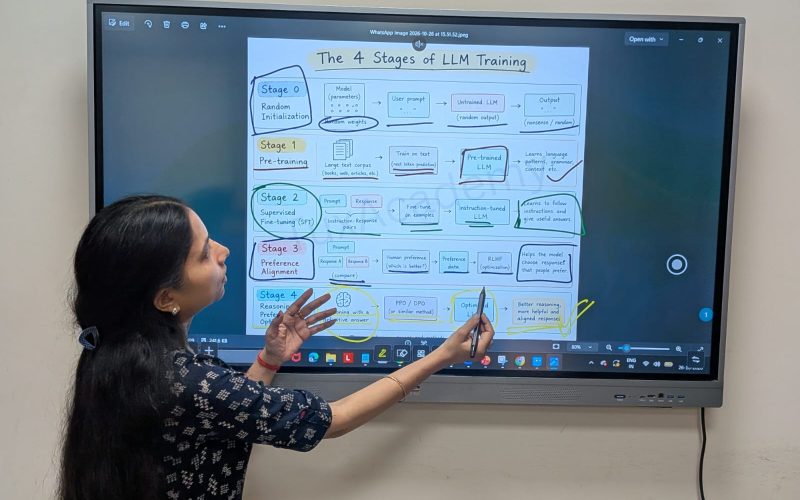
This article follows the exact flow of the diagram above, so you can scroll between the image and the text as you read. By the end, you will know:
- What a randomly initialized model is and why its output is useless
- How pre-training teaches a model language from a huge text corpus
- Why instruction fine-tuning makes a model conversational
- How preference fine-tuning and RLHF align the model with human taste
- How reasoning fine-tuning teaches the model to think before answering
- How you can build a career in this fast-growing field
Let us begin.
What Is an LLM? A Quick Refresher
A Large Language Model (LLM) is a type of machine learning model that is trained on massive amounts of text so it can understand and generate human language. It is built on a neural network architecture, most commonly the Transformer, and contains billions (sometimes trillions) of numerical values called parameters. These parameters are like tiny dials. Training is the process of adjusting those dials so the model’s predictions get better and better.
At its core, an LLM does one simple thing: it predicts the next piece of text (called a token) based on all the text that came before it. Everything else, from answering questions to writing poems and debugging code, emerges from getting very good at this one task and then shaping that ability through further training.
The four stages below shape that raw ability into something useful, safe and smart.
Stage 0: Randomly Initialized Model (The Blank Slate)
In the diagram, Stage 0 shows a user asking an untrained LLM: “What is an LLM?” The output? “Try peter hand and hello 4485n.” Complete nonsense.
What is happening here?
When engineers first build a model, they create the architecture (the layers, attention heads and connections) and then fill all the parameters with random numbers. This is called random initialization. At this moment, the model has seen no data and has learned nothing. It has no idea what English words are, what a question is or what an answer should look like.
So when you send it a query, the model does the math, but because the numbers are random, the output is also random. Think of it like a newborn baby handed a keyboard. The baby can press keys, but the result will not be a sentence.
Why is Stage 0 important?
Even though the output is useless, Stage 0 matters for three reasons:
- It is the starting point of all learning. Every LLM you have ever used began here.
- Good initialization helps stable training. Researchers carefully choose how random numbers are drawn so that training does not blow up or stall.
- It shows how much value training adds. The jump from Stage 0 to Stage 1 is the single biggest leap in the whole journey.
Key takeaway
A randomly initialized model is like an empty brain. It has the capacity to learn, but it knows nothing yet.
Stage 1: Pre-Training (Learning Language from a Huge Text Corpus)
Stage 1 in the image shows a stack of documents labeled “Huge Text Corpus” flowing into the Untrained LLM through a Train step, producing a Pre-Trained LLM.
What is pre-training?
Pre-training is the most expensive and data-hungry stage of the entire pipeline. The model is shown an enormous amount of text collected from books, websites, research papers, code repositories, encyclopedias, forums and more. We are talking about trillions of words.
The training objective is surprisingly simple: given the words so far, predict the next word. The model makes a guess, compares it with the real next word, calculates the error, and adjusts its parameters slightly to do better next time. This happens billions of times, across thousands of powerful GPUs, over weeks or months.
What does the model learn?
By repeating this prediction task at massive scale, the model quietly picks up:
- Grammar and syntax: how sentences are formed
- Vocabulary and meaning: which words relate to which
- World knowledge: facts about history, science, geography and technology
- Patterns of code: how programming languages are structured
- Basic reasoning patterns: simple logic that appears in written text
The big limitation: it only continues text
Look at the note at the bottom of the Stage 1 row in the image: “The LLM simply learns to continue the text instead of being conversational.”
This is a critical idea. A pre-trained model (often called a base model) is not a chatbot. If you ask it, “What is an LLM?”, it may reply with more questions such as “How do LLMs work? What are LLM parameters?” That is exactly what the diagram shows. Why? Because in its training data, a list of questions is often followed by more questions, like a quiz sheet or an FAQ page. The model is simply completing the pattern, not trying to help you.
Real-world analogy
Imagine a student who has read every book in a giant library but has never had a conversation with a teacher. This student knows an incredible amount, but when you ask a question, they might just continue your sentence or recite something related instead of giving a direct answer.
Key takeaway
Pre-training builds knowledge and language ability. It does not build helpfulness. That comes next.
Stage 2: Instruction Fine-Tuning (Teaching the Model to Be Conversational)
In Stage 2, the image shows two chat bubbles labeled “Instruction Response Pairs” being used to train the Pre-Trained LLM into an Instruction Fine-Tuned LLM.
What is instruction fine-tuning?
Instruction fine-tuning, also called Supervised Fine-Tuning (SFT), takes the pre-trained model and trains it further on a much smaller but carefully prepared dataset. Each example in this dataset is an instruction (or question) paired with an ideal response.
For example:
- Instruction: “What is an LLM?”
- Response: “An LLM is a type of ML model that is trained on large amounts of text to understand and generate human language.”
Thousands or even hundreds of thousands of such pairs are written by human experts or generated and carefully filtered. The model learns a new pattern: when a person asks something, the correct behavior is to give a clear, direct answer.
What changes after Stage 2?
Now when the user asks, “What is an LLM?”, the model replies with something like, “An LLM is a type of ML model that trained…” as shown in the image. It is no longer rambling or continuing the question. It is answering.
The note under Stage 2 says it perfectly: “The LLM becomes conversational, providing helpful answers.”
Why a small dataset is enough
This surprises many learners. Pre-training used trillions of words, but instruction tuning may use only a few hundred thousand examples. This works because the knowledge is already inside the model from Stage 1. Stage 2 simply teaches it the format and behavior of being an assistant. The model already knows the content; it just learns how to present it.
Common techniques in this stage
- Full fine-tuning: updating all parameters of the model
- LoRA and QLoRA: lightweight methods that update only a small number of added parameters, saving memory and cost
- Instruction dataset design: covering many task types such as summarization, translation, question answering, coding and classification
Key takeaway
Stage 2 transforms a text-completion engine into a helpful assistant that follows instructions.
Stage 3: Preference Fine-Tuning (Aligning with Human Preferences and RLHF)
Stage 3 is where things get interesting. The diagram shows a user asking, “What is an LLM?” The Instruction Fine-Tuned LLM generates two different responses: Response #1 and Response #2. A human picks the preferred response (marked with a green tick), and the other is rejected (marked with a red cross). The chosen result becomes an Instruction Response Pair that goes To RLHF.
Why do we need another stage?
After Stage 2, the model gives answers, but not all answers are equally good. One answer may be too long, another may be confusing, one may be slightly rude, and another may include unsafe or incorrect information. There are usually many possible ways to answer a question, and instruction fine-tuning alone cannot capture which one people actually prefer.
That is why we add preference fine-tuning.
How the process works (following the numbered steps in the image)
- Query: A user prompt such as “What is an LLM?” is given to the model.
- Multiple responses: The model generates two (or more) different answers.
- Human preference: A human reviewer compares the answers and selects the better one. This is the Preferred Response.
- Preference data is stored: The comparison is saved as a preference pair (chosen vs rejected).
- To RLHF: The data is used in Reinforcement Learning from Human Feedback.
What is RLHF?
RLHF (Reinforcement Learning from Human Feedback) is a technique where the model is rewarded for producing responses that humans prefer and discouraged from producing responses that humans dislike. Commonly, a separate reward model is first trained on the human comparisons so it can score any answer. Then the LLM is optimized, using algorithms such as PPO, to produce answers that earn a higher score.
There are also newer, simpler alternatives that use the same preference data directly, such as DPO (Direct Preference Optimization). All of them share the same goal: make the model’s behavior match what humans actually want.
What does preference tuning improve?
- Helpfulness: answers that truly solve the user’s problem
- Honesty: fewer confident-sounding mistakes
- Harmlessness: refusing dangerous or inappropriate requests politely
- Tone and style: clear, respectful, well-structured replies
Real-world analogy
Think of a new restaurant chef. Stage 2 teaches the chef the recipes. Stage 3 is like customers tasting two versions of the same dish and telling the chef which one they like more. Over time, the chef learns the taste of the audience.
Key takeaway
Stage 3 makes the model aligned, meaning it behaves in ways that humans find useful, safe and pleasant.
Stage 4: Reasoning Fine-Tuning (Teaching the Model to Think)
The last row of the image shows the newest and most exciting stage. A Preference Fine-Tuned LLM is given Reasoning with a Definitive Answer problems. It produces a Reasoning-Driven Response, then a Reward Calculation happens, and finally the system will “Update model params to increase the likelihood of higher-reward answers.”
What is reasoning fine-tuning?
Reasoning fine-tuning focuses on problems that have a clear, checkable, correct answer, such as maths problems, logic puzzles, coding challenges and structured science questions. Instead of relying only on human opinions about style, the system can automatically verify whether the final answer is right or wrong.
How it works (following the numbered flow in the image)
- Reasoning problems with a definitive answer: The model receives questions where the correct final answer is known.
- Reasoning-driven response: The model writes out its thinking step by step before giving the final answer.
- Reward calculation: The system checks the final answer (or runs the code or tests). A correct answer earns a high reward; a wrong answer earns a low reward.
- Update parameters: The model’s parameters are adjusted so that the reasoning paths that led to correct answers become more likely in the future.
Why is this a game changer?
Because the reward is based on verifiable correctness, the model can practice on huge numbers of problems without needing a human to judge each answer. Over many rounds, the model discovers useful reasoning habits by itself, such as:
- Breaking a big problem into smaller steps
- Double-checking its own work
- Trying a different approach when the first one fails
- Spending more “thinking time” on harder questions
This is the idea behind the modern generation of reasoning models that can solve complex maths, programming and science problems far better than earlier chatbots.
Stage 3 vs Stage 4: what is the difference?
Feature | Stage 3: Preference Fine-Tuning | Stage 4: Reasoning Fine-Tuning |
|---|---|---|
Goal | Match human taste and safety | Get correct, well-reasoned answers |
Feedback source | Human comparisons | Automatic checking of final answers |
Best for | Chat, writing, tone, safety | Maths, coding, logic, science |
Reward type | Learned from preferences | Based on verifiable correctness |
Key takeaway
Stage 4 teaches the model how to think, not just how to talk.
All 4 Stages at a Glance
Stage | Name | Input / Data | Result |
|---|---|---|---|
Stage 0 | Randomly initialized model | Random parameters | Random, meaningless output |
Stage 1 | Pre-training | Huge text corpus | Knows language, but only continues text |
Stage 2 | Instruction fine-tuning | Instruction-response pairs | Conversational, helpful answers |
Stage 3 | Preference fine-tuning | Human-ranked responses (RLHF) | Aligned, safe, preferred style |
Stage 4 | Reasoning fine-tuning | Problems with definitive answers + rewards | Step-by-step reasoning and higher accuracy |
Common Mistakes and Myths About LLM Training
Myth 1: “LLMs just copy and paste from the internet.” Not true. LLMs learn statistical patterns and generate new text word by word. They do not store pages like a search engine database.
Myth 2: “Pre-training alone makes a chatbot.” As the image shows, a pre-trained model only continues text. Stages 2 and 3 are what make it feel like a helpful assistant.
Myth 3: “More data always means a better model.” Data quality matters as much as quantity. Clean, diverse, well-filtered data usually beats a larger pile of noisy data.
Myth 4: “Fine-tuning needs the same cost as pre-training.” Fine-tuning is far cheaper. Techniques like LoRA let even small teams adapt models on a single GPU.
Myth 5: “Reasoning models are just bigger models.” Reasoning ability comes largely from the special training in Stage 4, where the model is rewarded for correct step-by-step thinking.
Why Understanding LLM Training Matters for Your Career
AI is no longer a niche subject. Companies across banking, healthcare, e-commerce, telecom, education and IT services are building or adopting LLM-powered solutions. Professionals who understand how these models are trained, fine-tuned and deployed are in very high demand.
Here are some roles where this knowledge is valuable:
- AI / ML Engineer: builds and fine-tunes models
- Prompt Engineer: designs effective prompts for business tasks
- MLOps and DevOps Engineer: deploys and scales LLM systems on Linux servers and cloud platforms
- Data Engineer: prepares the datasets used in training
- Cloud and Linux Administrator: manages GPU servers and containers that run AI workloads
- AI Product Manager: guides AI features from idea to launch
Most real AI workloads run on Linux, inside containers, on cloud GPUs. That is why strong Linux, cloud and DevOps fundamentals combined with AI knowledge create a powerful career profile.
Industry Use Cases: Where Each Training Stage Shows Up in Real Business
Banking and Finance
Instruction-tuned models answer customer queries, summarize loan documents and assist support teams. Preference tuning ensures safe, compliant and polite responses. Reasoning models help with risk calculations and structured analysis.
Healthcare
Models fine-tuned on medical instruction data can help summarize patient notes and answer general health information questions. Preference tuning is vital here to reduce harmful or misleading outputs, and human experts must always stay in the loop.
E-commerce and Retail
Conversational shopping assistants, product description generators and review summarizers rely heavily on instruction and preference fine-tuning.
IT Services and Software Development
Code assistants use reasoning fine-tuning, where the reward comes from passing unit tests. This is one of the clearest real-world examples of Stage 4 in action.
Education and EdTech
AI tutors explain concepts step by step. Reasoning-tuned models are especially useful for maths and science doubt-solving.
Telecom and Customer Support
Instruction-tuned chat agents resolve common issues quickly, while preference tuning keeps the tone calm, helpful and brand-friendly.
Trending in 2026: What Is New in LLM Training?
The field is moving fast. Here are some trends worth watching:
- Reasoning models are mainstream. More products now offer a “think longer” mode that uses Stage 4-style training.
- Smaller, efficient models. Companies are building compact models that can run on laptops, phones and local servers, which is great for privacy and low cost.
- Synthetic data. Models help generate high-quality training examples for other models, with careful filtering.
- Open-source momentum. Open models let students and startups experiment with fine-tuning on their own hardware.
- AI agents. Models that can plan, use tools and complete multi-step tasks build on reasoning and preference training.
- Local and Indian-language AI. There is rising demand for models that understand Hindi, Marathi and other regional languages and business contexts.
LLM and AI Learning in Mumbai: Local Opportunities
Mumbai is India’s financial capital and one of the strongest technology job markets in the country. From the corporate towers of BKC and Lower Parel to the IT parks of Andheri (East), Powai, Goregaon and Malad, and the growing tech belts of Navi Mumbai (Vashi, Belapur, Airoli) and Thane (Ghodbunder Road), companies are actively hiring professionals with AI, cloud and Linux skills.
Whether you live in Borivali, Kandivali, Dadar, Ghatkopar, Mulund, Kurla, Chembur or Dombivli, the Western, Central and Harbour lines make it easy to reach major tech hubs. Many learners also choose online or hybrid classes to save daily commute time.
For students in Mumbai, this is the right moment to learn:
- Linux administration (the base of every AI server)
- Cloud platforms and containers
- Python for AI and automation
- LLM fundamentals, prompt engineering and fine-tuning basics
- DevOps and MLOps workflows
If you are searching for an AI course in Mumbai, Linux training in Mumbai, DevOps course in Mumbai or an LLM training course near you, choosing a practical, hands-on, industry-focused institute makes all the difference.
Learn AI, Linux and DevOps with Tux Academy
Understanding the 4 stages of LLM training is just the beginning. To truly succeed in the AI era, you need strong technical foundations and real project experience. That is exactly what Tux Academy is built for.
Why learners choose Tux Academy
- Practical, hands-on training: learn by doing labs and real-world scenarios, not just theory
- Industry-focused curriculum: topics aligned with what employers actually look for
- Experienced mentors: guidance from professionals who understand the job market
- Beginner-friendly approach: start from the basics and grow step by step
- Career support: help with resume building, interview preparation and project guidance
- Flexible learning: options designed to suit students and working professionals
Who can join?
- Students and fresh graduates
- Working IT professionals who want to upgrade their skills
- System, network and cloud administrators
- Developers moving into AI and DevOps
- Career switchers from non-IT backgrounds
Take the next step today
Ready to build your future in AI, Linux and DevOps?
Visit tuxacademy.org to explore courses, check upcoming batches and book your free counselling session.
Seats in every batch are limited, so do not wait. Start learning today and be ready for the jobs of tomorrow.
Frequently Asked Questions (FAQ)
1. What are the 4 stages of LLM training?
The four main stages are pre-training, instruction fine-tuning, preference fine-tuning (RLHF) and reasoning fine-tuning. Before these, there is Stage 0, a randomly initialized model that produces meaningless output.
2. What is the difference between pre-training and fine-tuning?
Pre-training teaches the model language and general knowledge from a huge text corpus. Fine-tuning adjusts the pre-trained model for specific behavior, such as following instructions, matching human preferences or reasoning step by step.
3. Why does a pre-trained LLM not answer questions properly?
Because it is trained only to predict the next word. It continues the text instead of responding like an assistant. Instruction fine-tuning fixes this.
4. What is RLHF in simple words?
RLHF stands for Reinforcement Learning from Human Feedback. Humans compare model answers and choose the better one. The model is then trained to produce answers like the preferred ones.
5. What are instruction-response pairs?
They are training examples made of a question or instruction and a high-quality answer. They teach the model how to behave like a helpful assistant.
6. What is reasoning fine-tuning?
It is a training stage where the model solves problems with verifiable answers, gets a reward for correct results and updates its parameters so that good reasoning becomes more likely.
7. Do I need to know maths to learn LLMs?
Basic understanding of Python, statistics and linear algebra helps, but beginners can start with practical concepts and gradually learn the deeper maths.
8. Why is Linux important for AI and LLMs?
Most AI training and deployment happens on Linux servers, GPU machines and containers. Knowing Linux, shell scripting and cloud tools is a big advantage for AI and MLOps roles.
9. Can I learn LLM concepts in Mumbai?
Yes. Mumbai has many training options in classroom, online and hybrid formats. Choose a practical, mentor-led program like the ones offered by Tux Academy.
10. How long does it take to learn the basics of LLM training?
With consistent practice, most beginners can understand the core concepts in a few weeks. Building real fine-tuning skills and projects typically takes a few months.
Conclusion
The journey from a random, useless output to a thoughtful, reasoning AI follows a clear path:
- Stage 0 starts with a blank, randomly initialized model.
- Stage 1 (Pre-Training) gives it language and knowledge from a huge text corpus, but it only continues text.
- Stage 2 (Instruction Fine-Tuning) teaches it to be conversational and helpful.
- Stage 3 (Preference Fine-Tuning) aligns it with human preferences using RLHF.
- Stage 4 (Reasoning Fine-Tuning) rewards correct step-by-step thinking and improves accuracy on hard problems.
Understanding these stages gives you a real edge, whether you are a student, a developer or an IT professional planning your next career move. AI is shaping every industry, and the people who understand how it works will lead the change.
Start your learning journey with Tux Academy and turn curiosity into a career.
Explore Courses at tuxacademy.org
Suggested Internal Links
- Artificial Intelligence
- DevOps Course page
- Cloud Computing Course page
- Python for AI course page
- Contact / Free Counselling page