

Robotics Cybersecurity in 2026: TLS, AES-256, PKI, Digital Identity & Secure Robot Communication
Introduction: Why Cybersecurity Is Becoming Essential in Modern Robotics
Robotics is rapidly evolving from simple automated machines into intelligent, connected systems capable of interacting with humans, software platforms, sensors, cloud services and other machines. Modern robots are no longer limited to performing predefined mechanical tasks. They can collect data, process information, communicate over networks, make decisions using Artificial Intelligence (AI) and operate autonomously in complex environments.
From manufacturing facilities and warehouses to healthcare, agriculture, smart cities and industrial automation, robotics is transforming how businesses operate. However, as robots become more connected, they also become exposed to new cybersecurity challenges.
Imagine an autonomous robot operating inside a manufacturing facility. It communicates with a central server, receives commands through a network, sends sensor information to a cloud platform and continuously updates its operational status. If an unauthorized person gains access to its communication channel, manipulates its instructions or impersonates a legitimate control system, the consequences could extend beyond digital data and affect physical operations.
This is why cybersecurity is becoming an essential part of robotics engineering.
Technologies such as TLS, AES-256 encryption, X.509 certificates, Public Key Infrastructure (PKI), digital identity, hashing, cryptographic key management and Post-Quantum Cryptography (PQC) help create a security foundation for connected robotic systems.
The future of robotics is not only about developing machines that can move, think and perform tasks. It is also about building systems that can communicate securely, protect sensitive information, verify instructions and maintain trust.
1. Why Cybersecurity Matters in Robotics
Traditional robotics development primarily focused on mechanical design, electronic circuits, motors, sensors, controllers and programming logic. Today, connected robotic systems also depend on network communication, cloud computing, IoT technologies, AI applications and remote management platforms.
A modern robotic system may include:
Microcontrollers and embedded processors
Cameras and computer vision systems
Sensors and actuators
Wi-Fi, Ethernet and Bluetooth communication
IoT gateways
Robot Operating System (ROS or ROS 2)
MQTT communication
Cloud services
Remote monitoring applications
APIs and software update mechanisms
Every connected component creates a potential security boundary that needs to be considered.
A robot may be mechanically secure but digitally vulnerable. An attacker may not need physical access to the machine if the robot has a poorly protected network connection, weak authentication, insecure software or exposed credentials.
Common cybersecurity threats in robotics
Unauthorized access: Attackers may attempt to access robotic control interfaces, monitoring dashboards or management systems.
Data interception: Sensor information, operational data and communication messages may be exposed if appropriate security controls are missing.
Command manipulation: Instructions transmitted between a robot and its control system may be targeted for unauthorized modification.
Device impersonation: A malicious device may attempt to communicate with the robot network while pretending to be a legitimate machine.
Credential theft: Passwords, certificates, tokens or encryption keys may be exposed through poorly protected systems.
Firmware manipulation: Unauthorized software or firmware may introduce malicious functionality or compromise robot behaviour.
Replay attacks: Previously captured communication messages may be resent to attempt unauthorized actions.
Weak encryption: Outdated protocols or incorrect encryption configurations may expose sensitive communication.
For robotics manufacturers and businesses, cybersecurity is directly connected to operational reliability, production continuity, data protection, safety and customer trust.
2. TLS Protocol: Secure Communication Between Robots and Cloud Platforms
Transport Layer Security (TLS) is a widely used protocol designed to protect communication over networks. It helps provide confidentiality, integrity and authentication when properly configured.
In robotics, TLS can be used when a robot communicates with a cloud platform, remote monitoring application, API, IoT gateway or management server.
What does TLS provide?
TLS supports three important security properties:
Confidentiality: Helps prevent unauthorized parties from reading transmitted information.
Integrity: Helps detect unauthorized changes to communication.
Authentication: Helps verify the identity of communicating parties, depending on the configuration.
Consider a warehouse robot transmitting its battery status, location, temperature and operational information to a cloud dashboard.
Without appropriate security, network communication could potentially expose information or become a target for manipulation.
With TLS, communicating systems establish a protected connection using negotiated cryptographic parameters, authentication mechanisms and session keys.
How TLS works
A simplified TLS connection involves the following steps:
The robot initiates a connection with a server.
The client and server negotiate protocol and cryptographic parameters.
The server presents its digital certificate.
The robot validates the certificate and verifies the server’s identity.
The systems establish session secrets.
Secure communication begins.
The protected connection is closed or renewed when required.
TLS 1.3 is widely relevant to modern connected systems because it simplifies the handshake process and removes several legacy cryptographic options found in older TLS versions.
TLS applications in robotics
TLS may be used for:
Robot-to-cloud communication
Secure API connections
Remote robot monitoring
Firmware downloads
Web-based control dashboards
Robot fleet management
MQTT-based communication
Remote diagnostics
Secure telemetry transmission
However, using TLS alone does not automatically make a robotic system secure. Proper certificate validation, secure authentication, access control and safe configuration are equally important.
3. AES Encryption: Protecting Robotic Data
The Advanced Encryption Standard (AES) is a symmetric encryption algorithm widely used to protect digital information.
Symmetric encryption uses the same secret key for encryption and decryption. The communicating systems must securely obtain and protect that key.
Robotic systems process different types of sensitive data, including:
Sensor readings
Camera and vision system information
Navigation data
Machine configuration
Operational logs
Manufacturing information
Robot movement instructions
Stored credentials
Cloud-synchronized data
AES can help protect this information when stored or transmitted.
How AES encryption works
Suppose a robot stores operational information in a file.
Before encryption, the information may be readable by someone who obtains access to the file. After encryption, the information is transformed into ciphertext using a cryptographic key.
Without the appropriate key, an unauthorized person should not be able to practically recover the original data when a properly implemented encryption system is used.
The process can be represented as:
Plaintext → AES Encryption + Secret Key → Ciphertext
During decryption:
Ciphertext → AES Decryption + Secret Key → Original Data
AES key sizes
AES supports three standardized key sizes.
| AES variant | Key size |
|---|---|
| AES-128 | 128 bits |
| AES-192 | 192 bits |
| AES-256 | 256 bits |
AES-256 is commonly used in security-sensitive applications requiring strong encryption.
However, choosing AES-256 does not automatically make an application secure. The encryption mode, key generation, storage, nonce management, authentication and implementation quality all matter.
Authenticated encryption modes such as AES-GCM are particularly important because they can provide confidentiality and integrity protection when implemented correctly.
Applications of AES in robotics
AES may be used to protect:
Robot configuration files
Stored operational logs
Sensitive embedded-device information
Edge gateway storage
Communication payloads
Cloud-stored robotic information
Local backups
Other sensitive data
Robotics engineers should understand that encryption protects information, but cryptographic keys must also be protected. If an attacker obtains the encryption key, the security of the encrypted data may be compromised.
4. Digital Identity: Giving Every Robot a Unique Identity
In connected robotics environments, every device needs a reliable method of identifying itself.
Imagine a manufacturing facility containing hundreds of robotic devices. The central management platform must determine which robot is sending telemetry, which robot is requesting a software update and which device is permitted to receive specific commands.
If all robots use the same password or shared credential, compromising one device could increase the risk across the entire fleet.
A better approach is to assign every device a unique digital identity.
What is digital identity?
Digital identity represents a device, user, application or service within a digital environment.
A robot’s digital identity may be associated with:
A unique device identifier
Cryptographic public and private keys
Digital certificates
Registration records
Authentication credentials
Ownership information
Security policies
Access permissions
Digital identity enables systems to distinguish legitimate devices from unknown or potentially malicious devices.
Why unique identities are important
Unique device identities help organizations:
Authenticate individual robots
Manage permissions
Track device activity
Disable compromised devices
Revoke credentials
Monitor behaviour
Maintain audit records
Control robot onboarding and retirement
If one robot becomes compromised, administrators may revoke its certificate or restrict its access without necessarily disabling every other robot in the facility.
Digital identity is therefore an important foundation for robot fleet security, industrial IoT deployments and connected automation systems.
5. X.509 Certificates: Verifying Robot Identity
X.509 is a widely used standard for digital certificates. It associates an identity with a public key and contains information that supports certificate validation.
In robotics, certificates can be used to authenticate devices, servers, gateways and other components.
What does an X.509 certificate contain?
Depending on its configuration, an X.509 certificate can include:
Subject information
Public key
Issuer information
Certificate validity period
Serial number
Signature algorithm
Digital signature
Extensions and usage restrictions
A certificate is not the same as a private key. The private key must remain securely protected by the device or authorized key-management system.
How certificate-based authentication works
A simplified process involves:
A robot is provisioned with its identity and private key.
A certificate is issued that associates the robot’s identity with its public key.
The robot attempts to connect to a trusted platform.
The platform validates the robot’s certificate.
The robot proves possession of its corresponding private key.
The platform checks the robot’s permissions.
The connection is accepted or rejected.
Simply presenting a certificate is not enough. The system must also verify the certificate and establish that the device controls the private key associated with it.
Why X.509 certificates are useful
Certificate-based authentication can support:
Secure robot onboarding
Mutual TLS authentication
Cloud device registration
Robot fleet identity
Secure gateway connections
Certificate-based access control
Device lifecycle management
For example, AWS IoT Core supports X.509 client certificates for device authentication, allowing connected devices to use individual certificates within a managed IoT environment.
6. PKI: The Trust Infrastructure Behind Connected Robotics
Public Key Infrastructure (PKI) is a framework for establishing, managing, validating and revoking digital certificates.
A certificate alone does not automatically establish trust. The system must determine whether the certificate was issued by an accepted authority, whether it is valid and whether it should still be trusted.
PKI provides the infrastructure to manage these relationships.
Main components of PKI
Certificate Authority (CA): A trusted organization or system that issues and signs certificates according to defined policies.
Root certificate: A trust anchor that forms the foundation of a certificate hierarchy.
Intermediate certificate: A certificate authority that operates under a root CA and can issue certificates to devices or other entities.
End-entity certificate: A certificate assigned to a robot, server, gateway, application or other endpoint.
Certificate revocation: A process used to invalidate certificates when they should no longer be trusted.
Example of PKI in a robotics facility
Suppose a company deploys autonomous robots across its manufacturing facility.
The organization can establish a private PKI for its robotic devices.
A trusted root CA establishes the trust hierarchy.
An intermediate CA issues certificates to robotic devices.
Each robot receives a unique identity.
The robot uses its certificate during authentication.
The management platform validates the certificate.
Permissions are assigned to individual robots.
Compromised or retired certificates can be revoked.
This creates a scalable foundation for managing hundreds or thousands of connected machines.
Digital identity versus PKI
Digital identity represents the device, while PKI provides a certificate-based framework for establishing and managing trust in that identity.
A robotics fleet may have thousands of digital identities, while PKI provides the infrastructure for authenticating and validating those identities.
7. Symmetric and Asymmetric Cryptography: Two Different Key Approaches
Cryptography is one of the fundamental foundations of modern cybersecurity.
Two important approaches are symmetric cryptography and asymmetric cryptography. Both are useful, but they solve different problems.
Symmetric cryptography
Symmetric cryptography uses the same secret key for encryption and decryption.
Advantages:
High performance
Efficient for large amounts of data
Suitable for embedded systems
Generally lower computational overhead than many public-key operations
Limitations:
Secret keys must be securely distributed.
Key compromise can expose protected information.
Managing keys across large robot fleets can become complex.
AES is an example of symmetric encryption.
A robot may use symmetric encryption to protect sensor data, operational logs or communication traffic.
Asymmetric cryptography
Asymmetric cryptography uses a key pair:
Public key
Private key
The keys are mathematically related, but the private key is designed to remain protected and cannot practically be derived from the public key using currently known classical methods when appropriately selected cryptographic algorithms are used.
Asymmetric cryptography supports:
Authentication
Digital signatures
Secure key establishment
Certificate-based identity
Understanding a public and private key
Public key: Can be shared with others and used in supported cryptographic operations.
Private key: Must remain protected and is used for operations such as signing or private-key-based cryptographic processes.
The public and private keys work together, but the private key should never be exposed.
Symmetric versus asymmetric cryptography
| Feature | Symmetric | Asymmetric |
|---|---|---|
| Keys | Shared secret key | Public/private key pair |
| Performance | Generally fast | Often computationally heavier |
| Main use | Data encryption | Authentication, signatures, key establishment |
| Key distribution | Secret must be shared securely | Public key can be distributed |
| Example | AES | RSA, ECC |
| Robotics application | Protecting data | Device identity and authentication |
Modern secure systems frequently use both technologies together rather than relying on only one.
8. Hashing: Detecting Changes in Robot Software and Data
Hashing is a cryptographic process that takes input data of varying length and produces a fixed-length output called a hash or digest.
Unlike encryption, hashing is not designed to be reversible.
Why hashing is important in robotics
Robotic systems depend on software integrity, firmware, configuration files and reliable sensor-processing pipelines.
Hashing can help detect whether information has changed.
Applications include:
Firmware integrity verification
Software package verification
Configuration file integrity
Audit log verification
Digital signature processes
Detection of unauthorized file modifications
Example: Firmware integrity verification
Suppose a manufacturer releases a firmware package for a robotic device.
The manufacturer calculates a cryptographic hash of the approved firmware. When the package reaches the robot, the update system calculates the hash of the received package and compares it with the expected value.
If the values differ, the package may have been modified, corrupted or downloaded incorrectly.
However, hashing alone does not establish who created the file. If an attacker can replace both the firmware and the expected hash, a simple hash comparison may not prevent malicious substitution.
This is why digital signatures and trusted verification mechanisms are important for authenticated software updates.
Hashing versus encryption
| Hashing | Encryption |
|---|---|
| Produces a fixed-length digest | Produces encrypted data |
| Designed to be one-way | Designed to be reversible with the required key |
| Used for integrity verification | Used for confidentiality |
| Does not hide the original data through reversible protection | Protects information from unauthorized reading |
Hashing, encryption and digital signatures are different mechanisms that are often combined in secure robotic architectures.
9. Key Management: Protecting the Keys Behind Encryption
Encryption algorithms are often discussed as the main security solution, but cryptographic keys are frequently the most sensitive part of a security system.
Even a strong algorithm such as AES-256 can become ineffective if the key is stored insecurely, reused incorrectly, exposed through software logs or shared across an entire robot fleet.
Key management covers the complete lifecycle of cryptographic keys:
Key generation
Key provisioning
Key storage
Key access
Key usage
Rotation
Backup
Recovery
Revocation
Destruction
Why key management matters in robotics
Consider 1,000 robots deployed across a logistics network.
If every robot uses the same encryption key, compromise of one device may expose the key used by the entire fleet.
A stronger architecture uses unique credentials and appropriately separated cryptographic keys, with access controls designed to limit the impact of compromise.
Recommended key-management practices
Secure key generation: Use appropriate cryptographically secure random-number generation methods.
Avoid hard-coded secrets: Embedding shared credentials directly in firmware creates risks, particularly when devices can be physically inspected or software extracted.
Protect private keys: Use secure storage or hardware-backed mechanisms where available and appropriate.
Separate keys by purpose: Keys used for authentication, encryption, signing and other purposes should not be indiscriminately reused.
Rotate keys when required: Establish rotation policies based on risk, device capabilities and lifecycle requirements.
Revoke compromised credentials: A compromised robot should not retain unrestricted access to networks or cloud platforms.
Plan device retirement: When robots are sold, returned, reassigned or decommissioned, credentials and stored secrets must be handled securely.
Key management is not a one-time task. It is a continuous process throughout the operational lifecycle of a robotic device.
10. AWS IoT and Cloud-Connected Robotics
Cloud platforms are increasingly used to connect robotic devices with centralized monitoring, analytics, fleet management and remote operations.
Cloud-connected robotics may use IoT services to:
Receive telemetry
Monitor device health
Send commands
Manage device identities
Update firmware
Store operational information
Analyze robot performance
Track deployment status
Detect unusual behaviour
AWS IoT is one example of a cloud ecosystem supporting connected device authentication and management.
AWS IoT and certificate-based identity
AWS IoT Core supports X.509 client certificates for device authentication.
A robotic device can use a certificate to establish a secure connection with an IoT platform. The certificate is registered and managed according to the platform’s authentication requirements.
Unique certificates help administrators manage individual devices, including disabling or revoking credentials when necessary.
A simplified robotics architecture
A cloud-connected robotic system may operate through the following layers:
Robotic Device
Sensors, motors, controller, camera and embedded software.
Secure Communication
TLS, authentication, MQTT and device identity.
IoT Gateway or Edge Layer
Local processing, policy enforcement, data handling and edge analytics.
Cloud Platform
Monitoring, fleet management, storage, analytics, dashboards and software updates.
Why edge computing matters
Not every robot should depend entirely on a cloud connection.
Robots may need to continue operating when internet connectivity is unavailable, delayed or unstable.
Edge computing allows robots and nearby gateways to process information locally.
Its benefits may include:
Lower communication latency
Faster decision-making
Reduced cloud dependence
Lower bandwidth requirements
Better control over local data
Improved operational resilience
Security must extend across the robot, edge gateway, cloud platform and management infrastructure.
A secure cloud connection does not automatically make the robot’s local network, firmware or control logic secure.
11. Post-Quantum Cryptography (PQC): Preparing Robots for the Quantum Era
Post-Quantum Cryptography is one of the emerging areas of cybersecurity that engineers and technology organizations need to understand.
Quantum computing may eventually threaten certain public-key cryptographic systems widely used today. Algorithms such as RSA and elliptic-curve cryptography could become vulnerable to sufficiently capable cryptographically relevant quantum computers.
This does not mean every encryption algorithm will suddenly become useless. The impact is particularly important for public-key systems used for key establishment and digital signatures.
Why robotics should consider PQC
Robotic devices often have long operational lifecycles.
An industrial robot, autonomous vehicle component, warehouse automation system or critical infrastructure machine may remain in service for many years.
A device manufactured today may still be operating when cryptographic requirements change.
Robotics manufacturers should therefore consider:
Long-term confidentiality
Secure firmware signing
Certificate lifecycle management
Cryptographic migration
Device hardware limitations
Memory and processing constraints
Communication overhead
Compatibility with existing systems
What is Post-Quantum Cryptography?
PQC refers to cryptographic algorithms designed to resist attacks from both classical computers and sufficiently capable quantum computers.
NIST has introduced important post-quantum cryptographic standards, including:
ML-KEM: Key encapsulation
ML-DSA: Digital signatures
SLH-DSA: Digital signatures
ML-KEM is associated with secure key establishment, while ML-DSA and SLH-DSA are designed for digital signatures.
These technologies can become relevant to secure robot communication, device authentication, software signing and long-term trust infrastructure.
PQC in industrial IoT
Industrial robots and IoT devices may communicate using TLS, MQTT, OPC UA or other industrial protocols.
Post-quantum migration may involve introducing hybrid cryptographic approaches that combine conventional and post-quantum methods during the transition.
Hybrid approaches can be useful because industrial systems cannot necessarily replace every device, network or security component simultaneously.
The practical challenge
Robotics hardware has different capabilities.
Some robots have powerful processors, while others use inexpensive microcontrollers with limited RAM, storage, power and bandwidth.
Post-quantum cryptographic algorithms may introduce changes in:
Key sizes
Signature sizes
Handshake message sizes
CPU requirements
Memory usage
Communication latency
Energy consumption
Robotics engineers must therefore evaluate cryptographic choices against the actual capabilities of their hardware.
The objective is not simply to use the newest algorithm. It is to design a security architecture that can evolve over time.
12. Secure Robot Communication: A Real-World Industrial Scenario
Consider a smart warehouse where autonomous mobile robots transport products between storage areas and packing stations.
The system includes autonomous robots, wireless networks, central management software, IoT gateways, cloud dashboards, warehouse sensors and inventory databases.
A robot receives instructions to travel to a particular location, collect an item and deliver it to a designated station.
How should the system protect its communication?
Layer 1: Device identity
Every robot should have a unique identity. The management system should identify which robot is requesting a connection or sending telemetry.
Layer 2: Authentication
The robot and platform should verify the identity of the communicating party. Certificate-based authentication or another appropriately designed mechanism may be used.
Layer 3: Secure communication
TLS can protect network communication against interception and unauthorized modification when correctly configured.
Layer 4: Data encryption
Sensitive data stored on robots, gateways or cloud platforms should be encrypted where appropriate.
Layer 5: Access control
A robot should receive only the permissions required to perform its tasks. A warehouse transport robot should not automatically have administrative permission to modify the entire robot fleet.
Layer 6: Secure firmware
Firmware updates should be authenticated and verified before installation.
Layer 7: Key management
Cryptographic credentials should be managed throughout the device lifecycle.
Layer 8: Monitoring
The system should identify abnormal behaviour, unusual access patterns and suspicious commands.
Layer 9: Incident response
If a robot is compromised, administrators should have a procedure to isolate the device, revoke its credentials, investigate the incident and restore a trusted state.
A layered security approach is more effective than relying on a single technology.
13. Common Cybersecurity Mistakes in Robotics and IoT Projects
Robotics students and developers often concentrate on building functionality first. Security is sometimes added at the end, which can create architectural problems.
Common mistakes include:
Using the same credentials on every device
Shared passwords or keys make it difficult to isolate compromised devices.
Ignoring certificate validation
Using TLS without properly validating the server certificate can undermine secure communication.
Storing secrets directly in source code
Hard-coded keys, passwords and tokens may be exposed through repositories, firmware images or debugging processes.
Using encryption without authentication
Encryption alone may not provide the required integrity and authenticity protection.
Ignoring firmware security
A robot may have secure network communication but still accept unauthorized firmware.
Using outdated protocols
Legacy cryptographic algorithms and insecure protocol configurations may expose devices to known weaknesses.
Failing to update devices
Robots need security updates, vulnerability management and a realistic patching process.
Poor network segmentation
Robotic devices should not automatically have unrestricted access to every corporate system.
Ignoring the device lifecycle
Security must account for provisioning, operation, maintenance, replacement and decommissioning.
Treating security as only a software problem
Physical access, hardware protection, debugging interfaces, storage, supply-chain integrity and operational procedures can all influence security.
Robotics cybersecurity should be considered during design, development, testing, deployment and maintenance.
14. Robotics Cybersecurity Projects Students Can Build
Practical projects can turn abstract cryptographic concepts into measurable engineering outcomes.
Project 1: AES-Encrypted Robot Sensor Data
Objective: Protect sensor data before transmitting it over a network.
Build a robotic prototype that collects sensor values and sends them to a monitoring application. Implement encryption for transmitted information and compare protected data with original sensor output.
Technologies: Python, ESP32 or Raspberry Pi, sensors, AES-GCM and communication interfaces.
Learning outcome: Understand encryption, plaintext, ciphertext, cryptographic keys and authenticated data protection.
Project 2: Secure Robot Authentication Using Digital Identity
Objective: Ensure that only registered robots can connect to a monitoring system.
Create a system in which each robot is assigned a unique identity and credential. The server validates the device’s authentication information before accepting data.
Technologies: Python, certificates, TLS, device identity and authentication.
Learning outcome: Understand why unique device identities are preferable to shared credentials.
Project 3: TLS-Protected Robot Monitoring Dashboard
Objective: Secure communication between a robotic device and a monitoring application.
Create a dashboard displaying robot status, temperature, battery level, movement information, sensor data and connection status.
Implement a secure communication channel between the device and the dashboard server.
Learning outcome: Understand secure network communication, TLS certificates and application-level security.
Project 4: Firmware Integrity Verification
Objective: Detect unauthorized modification of robotic software.
Develop a prototype update process that verifies a firmware package before allowing installation. The system may use cryptographic hashing and digital signatures to check the integrity and authenticity of update files.
Learning outcome: Understand software integrity, hash functions, digital signatures and secure update mechanisms.
Project 5: IoT Robot with AWS Cloud Connectivity
Objective: Connect a robotic device to a cloud-based IoT platform.
Develop a system that transmits robot telemetry, authenticates the device and enables remote monitoring.
Explore how device identity, secure communication and access policies protect connected systems.
Technologies: ESP32 or Raspberry Pi, MQTT, AWS IoT Core, TLS and device certificates.
Learning outcome: Understand cloud-connected robotics, IoT device authentication and secure device management.
Project 6: Post-Quantum Cryptography Research Prototype
Objective: Explore how future cryptographic algorithms may influence robotic communication.
Develop a research prototype using supported post-quantum cryptographic libraries and compare selected parameters against a classical cryptographic baseline.
Measure handshake duration, CPU utilization, memory requirements, message sizes and communication overhead.
Learning outcome: Understand why cryptographic migration is a hardware, software and network engineering challenge-not simply an algorithm replacement.
These projects can help students connect theory with practical engineering, build portfolios and prepare for technical interviews, internships and robotics research.
15. Robotics, AI and Cybersecurity: The Industry Connection
Robotics is increasingly connected with AI-based decision-making, computer vision, autonomous navigation, predictive maintenance and industrial automation.
This creates opportunities for engineers who understand both system functionality and system security.
AI-powered robots
AI may help robots recognize objects, interpret visual information, understand their surroundings and make decisions.
However, AI-powered robotics also introduces security considerations such as:
Manipulation of input data
Unauthorized model access
Data poisoning
Model integrity
Adversarial inputs
Privacy risks
Unauthorized access to AI services
Autonomous systems
Autonomous robots may perform tasks with reduced human intervention.
Such systems require reliable communication, secure software, controlled access, monitoring and appropriate safety mechanisms.
Industrial automation
Factories use connected devices, PLCs, sensors, robotic arms, industrial controllers and monitoring systems.
Security weaknesses in connected components may affect production operations.
Smart manufacturing
Smart manufacturing depends on communication between machines, software, production systems and management platforms.
Cybersecurity supports the reliability of these connected environments.
Healthcare robotics
Healthcare robots may interact with patients, transport equipment, assist clinical workflows or process sensitive information.
Data confidentiality, authentication and secure operation become particularly important.
The combination of robotics, AI, IoT and cybersecurity is becoming relevant across multiple industries.
16. Robotics Education and Technical Skill Development in Greater Noida and Delhi NCR
The future of robotics engineering is becoming interdisciplinary. Students increasingly need to understand how programming, electronics, automation, AI, IoT and cybersecurity work together.
For learners in Greater Noida, Noida and the Delhi NCR region, robotics provides opportunities to explore practical engineering, automation, embedded systems, intelligent machines and connected technologies.
Technology and education ecosystems around Knowledge Park, Greater Noida, Noida Extension and Delhi NCR create a relevant environment for students exploring engineering, automation, robotics, AI and IoT careers.
Rather than learning only through theoretical explanations, students should aim to work with real components, develop prototypes, experiment with code and solve practical problems.
What practical robotics learning should include
Understanding robotic system components
Working with microcontrollers
Connecting sensors and actuators
Writing and debugging code
Building small robotic prototypes
Understanding communication between devices
Learning how robots receive and execute commands
Exploring IoT connectivity
Developing problem-solving skills
Applying engineering concepts through projects
For students interested in future careers, combining robotics with programming, AI, IoT and cybersecurity can create a stronger technical foundation.
Robotics is not simply about assembling machines. It is about understanding how mechanical, electronic and digital systems work together.
Classroom learning: Understanding cryptography and secure robotics
Students studying robotics and cybersecurity need to understand how theoretical concepts are applied to real systems. Topics such as encryption, digital identity, certificates, PKI, symmetric and asymmetric cryptography and key management become easier to understand when discussed through technical examples, classroom explanations and practical demonstrations.
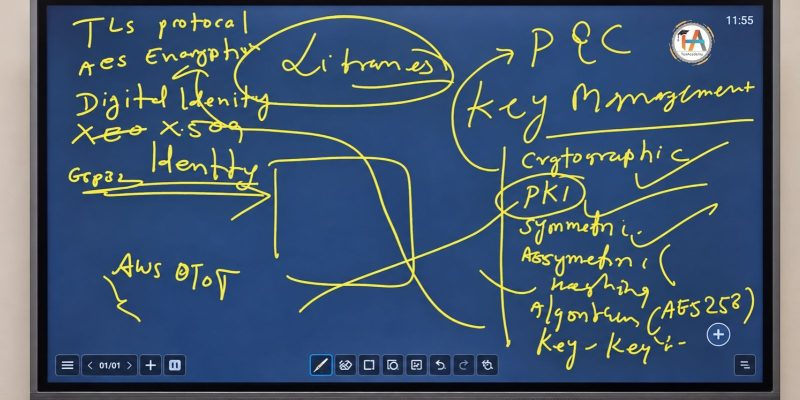
Classroom learning session covering cryptography, TLS, AES encryption, digital identity, PKI and secure communication concepts relevant to connected robotics and IoT systems.
This type of learning helps students connect cybersecurity concepts with modern robotics, cloud-connected devices, industrial automation and secure communication.
Understanding how these technologies work together can help learners develop a practical engineering mindset instead of limiting their knowledge to definitions and theory.
Students exploring robotics in Greater Noida and Delhi NCR can benefit from combining programming, electronics, networking and cybersecurity fundamentals with project-based learning.
17. Robotics Cybersecurity Career Opportunities
As robotics continues to evolve, career opportunities are expanding beyond traditional mechanical design and robot programming.
The development of connected robotic systems has created demand for professionals who understand hardware, software, communication networks, automation and security.
| Career | Skills required |
|---|---|
| Robotics Engineer | Robot programming, electronics, control systems, sensors |
| Embedded Systems Engineer | C/C++, microcontrollers, hardware communication |
| IoT Engineer | MQTT, networking, device communication, cloud connectivity |
| Robotics Software Developer | Python, C++, ROS, Linux |
| Automation Engineer | Industrial automation, PLC, control systems |
| Cybersecurity Engineer | Network security, cryptography, authentication, security testing |
| AI Robotics Developer | Machine learning, computer vision, AI integration |
| Industrial IoT Security Engineer | Device identity, TLS, PKI, IoT security and monitoring |
Students who combine robotics fundamentals with programming, networking and cybersecurity can develop a wider range of technical skills.
For example, a robotics engineer who understands TLS, AES, device identity and secure communication may be better prepared to contribute to connected robotics projects than someone who understands only basic robot movement.
The goal is not to become an expert in every technology immediately. The goal is to build a foundation that allows you to understand how different engineering disciplines connect.
18. A Practical Roadmap to Learning Robotics and Secure Connected Systems
If you are starting your robotics journey, avoid trying to learn every technology at the same time. Follow a structured learning path.
Stage 1: Electronics and Hardware
Learn sensors, motors, circuits, microcontrollers, basic electrical concepts and hardware connections.
Stage 2: Programming
Develop programming fundamentals using Python, C/C++, logic building, debugging and embedded programming.
Stage 3: Robotics and Automation
Explore robot movement, control systems, sensors, actuators and project development.
Stage 4: IoT and Networking
Learn device communication, MQTT, networking, cloud connectivity and edge computing.
Stage 5: Cybersecurity
Study encryption, AES, TLS, PKI, digital identity, certificates, authentication and key management.
Stage 6: Advanced Robotics Projects
Build AI-based robotics applications, autonomous systems, secure IoT robots, cloud-connected automation and research prototypes.
This roadmap provides a progression from basic hardware knowledge to advanced connected robotics.
Students should focus on understanding concepts, developing working projects and learning how to solve practical engineering problems.
19. Why Robotics Students Should Understand Cryptography
Cryptography may initially appear to be a topic reserved for cybersecurity professionals. However, it is increasingly relevant to engineers developing connected machines.
When a robot communicates with a server, receives software updates, sends sensor data or connects to a remote management system, cryptography becomes part of the system architecture.
Understanding these concepts helps robotics developers make better engineering decisions:
Why data needs encryption
How encryption keys are generated
Why private keys should remain protected
How certificates establish trust
Why TLS is used for communication
How hashing helps detect modifications
How digital signatures verify software
Why devices need unique identities
How authentication differs from authorization
Why cryptographic algorithms may need to evolve
These are not simply theoretical cybersecurity topics. They influence how robotic products are designed, deployed, maintained and protected throughout their operational lifecycle.
A robotics student who understands these concepts can begin asking better questions when designing a system:
How will my robot identify itself?
How will it verify the server?
What happens if its credentials are compromised?
How are software updates verified?
Where are cryptographic keys stored?
How can the system prevent unauthorized commands?
What happens if the network connection is interrupted?
Can the device support future security requirements?
These questions represent the difference between building a robot that works and designing a connected robotic system that can operate responsibly in a real environment.
20. The Future of Robotics Security: From Connected Machines to Trusted Autonomous Systems
The next generation of robotics will likely involve larger fleets of connected machines, more autonomous decision-making, increased cloud connectivity and more complex software ecosystems.
Robots will increasingly communicate with other robots, AI systems, smart sensors, cloud platforms, edge gateways, industrial control systems, mobile applications and digital twins.
As this ecosystem grows, cybersecurity will need to evolve alongside robotics technology.
Zero-trust principles
Devices and users should not automatically be trusted simply because they are connected to an internal network.
Unique device identity
Each robot should have an identifiable, manageable and verifiable identity.
Hardware-backed security
Secure elements, trusted hardware and protected key storage may help safeguard sensitive cryptographic material.
Secure boot
Devices should verify that the software they execute comes from an authorized source and has not been improperly modified.
Continuous monitoring
Robotic systems should be monitored for suspicious behaviour, abnormal communication and unauthorized access.
Cryptographic agility
Systems should be designed to allow cryptographic algorithms and security policies to evolve without requiring complete redesigns whenever standards or threat models change.
Post-quantum migration
Robots expected to remain in operation for many years may require a strategy for transitioning to quantum-resistant cryptographic technologies.
Security throughout the lifecycle
Security should be considered from design and manufacturing through deployment, maintenance, upgrades and retirement.
The direction is clear: robotics systems need to be designed with security and long-term maintainability in mind, rather than relying on emergency fixes after deployment.
Conclusion: The Future of Robotics Will Be Intelligent, Connected and Secure
Robotics is moving toward a future where machines will communicate, learn, collaborate and operate with increasing autonomy.
The integration of AI, IoT, cloud computing, embedded systems and industrial automation is creating new possibilities for manufacturing, healthcare, logistics, agriculture, education and smart infrastructure.
But connectivity also creates responsibility.
A robot needs more than sensors, motors, algorithms and programming logic. It also needs a trusted identity, secure communication, protected data, reliable authentication, secure software updates and carefully managed cryptographic keys.
TLS helps establish secure communication channels. AES can protect sensitive data. X.509 certificates support digital identity and authentication. PKI provides a framework for managing digital trust. Symmetric and asymmetric cryptography serve different purposes in secure system design. Hashing helps detect changes in information. Key management protects the foundation of cryptographic security. Post-Quantum Cryptography is beginning to influence how engineers think about the long-term security of connected devices.
These technologies are not separate from robotics. They are becoming part of the engineering knowledge required to develop modern intelligent machines.
For students, developers and aspiring robotics engineers, the opportunity is to move beyond basic projects and understand the complete ecosystem behind connected robotics.
Learn the hardware. Understand the programming. Explore networking. Build IoT projects. Study cybersecurity. Experiment with encryption. Develop practical projects that combine these technologies.
The next generation of robotics engineers will not only build machines that can move, sense and think. They will help build machines that can communicate securely, operate reliably and earn trust in the real world.
The future of robotics is not just automation. It is intelligent automation built on secure, connected and trusted systems.
Frequently Asked Questions (FAQs)
1. Why is cybersecurity important in robotics?
Robots increasingly communicate through networks, cloud services and connected devices. Cybersecurity helps protect them against unauthorized access, data interception, command manipulation, malicious software and identity-related attacks.
2. What is TLS in robotics?
TLS is a communication security protocol used to help protect data exchanged between robotic systems, servers, gateways and cloud services. It supports encryption, integrity protection and authentication depending on the configuration.
3. What is AES-256 encryption?
AES-256 is a symmetric encryption algorithm that uses a 256-bit key. It can be used to protect sensitive robotic data, stored files, communication information and other digital assets.
4. What is the difference between TLS and AES?
TLS is a communication security protocol that helps establish and protect secure network connections. AES is an encryption algorithm used to protect data. AES can be used within TLS to encrypt communication traffic.
5. What is digital identity in robotics?
Digital identity allows a robot to be uniquely identified within a connected system. It may use device identifiers, certificates and cryptographic credentials to establish its identity.
6. What are X.509 certificates used for in robotics?
X.509 certificates can associate a device identity with a public key. They can be used to authenticate robots, IoT devices, gateways and servers.
7. What is PKI?
Public Key Infrastructure is a framework for issuing, validating, managing and revoking digital certificates. It helps establish trust between devices and services.
8. What is the difference between symmetric and asymmetric cryptography?
Symmetric cryptography uses a shared secret key for encryption and decryption. Asymmetric cryptography uses a public/private key pair and supports functions such as digital signatures, authentication and key establishment.
9. What is hashing in robotics cybersecurity?
Hashing converts data into a fixed-length digest. It can be used to detect file modifications, verify software integrity and support digital signature processes.
10. What is Post-Quantum Cryptography?
Post-Quantum Cryptography refers to cryptographic algorithms designed to resist attacks from classical and quantum computers. It is important for systems that may require long-term security.
11. Can robotics students learn cybersecurity?
Yes. Students can begin with programming, networking, encryption fundamentals, device authentication and IoT security. Practical projects help them understand how cybersecurity is applied to robotic systems.
12. What projects combine robotics and cybersecurity?
Projects include encrypted sensor communication, secure robot authentication, TLS-protected dashboards, firmware integrity verification, secure MQTT communication and cloud-connected robots with unique device identities.
13. Is robotics a good career option for students in Greater Noida?
Robotics offers opportunities across automation, embedded systems, AI, manufacturing, IoT, research and software development. Students in Greater Noida and Delhi NCR can build their technical foundation through practical learning, projects and relevant engineering skills.
Build the Skills Behind the Next Generation of Robotics
Robotics is evolving beyond hardware and programming. Today’s intelligent machines depend on automation, AI, embedded systems, IoT connectivity and cybersecurity.
Whether you are a student, engineering learner or technology enthusiast, developing practical skills and understanding real-world applications can help you prepare for the next generation of intelligent technology.
Explore technology learning opportunities and practical engineering concepts with TuxAcademy.
1. Robotics Training in Greater Noida
Build a strong foundation in robotics by learning about automation, electronics, programming and practical robotics applications. Explore the Robotics Training in Greater Noida program to understand the technologies shaping modern industries.
2. Cybersecurity Training in Greater Noida
Learn about network security, ethical hacking, encryption and digital protection techniques. Explore Cybersecurity Training in Greater Noida to understand how modern systems and connected devices can be protected against cyber threats.
3.Artificial Intelligence Course
Understand how artificial intelligence is transforming automation, robotics and modern business applications. Explore the Artificial Intelligence Course at TuxAcademy to learn about AI concepts and their practical applications.
4.Robotics Engineering in India: Career Scope and Industry Opportunities
Robotics engineering is gaining importance across industries such as manufacturing, healthcare, automotive, logistics and industrial automation. Understanding robotics technologies, automation systems and intelligent machines can help students prepare for emerging technical opportunities. Explore Robotics Engineering in India to learn more about the field, its industry applications and career scope.
5.Cybersecurity Jobs in India: Career Opportunities and Industry Demand
As businesses increasingly depend on connected systems, cloud platforms and digital infrastructure, the demand for cybersecurity professionals continues to grow. Skills in network security, ethical hacking, encryption and threat analysis are valuable for understanding modern security challenges. Read Cybersecurity Jobs in India to explore industry developments, hiring trends and career opportunities.