

Have you ever wondered how artificial intelligence understands human language? How does a machine interpret words, sentences, and meaning without actually knowing any language like humans do?
This is where the concept of word embeddings comes into play. Word embeddings are one of the most powerful ideas in Natural Language Processing and form the foundation of modern AI systems such as chatbots, translation tools, and content generation platforms.
In this blog, we will break down the concept of word embeddings in the simplest possible way so that students and professionals can understand how AI processes language.
Watch the Concept Explained
Direct link:
What is Natural Language Processing
Natural Language Processing, commonly known as NLP, is a field of artificial intelligence that enables machines to understand, interpret, and generate human language.
Examples of NLP in daily life include:
- Chatbots answering customer queries
- Voice assistants responding to commands
- Email spam filters
- Language translation tools
However, computers do not understand words the way humans do. They only understand numbers. This is where word embeddings become essential.
Why Computers Cannot Understand Words Directly
Humans understand words based on meaning, context, and experience. For example:
- The word bank can mean a financial institution
- Or it can refer to the side of a river
A computer cannot interpret this difference unless it is trained properly.
Machines require a mathematical representation of words. This representation must capture meaning, relationships, and context. Word embeddings solve this problem.
What are Word Embeddings
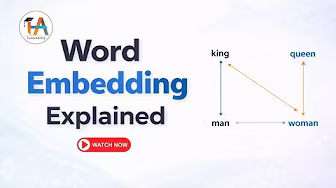
Word embeddings are numerical representations of words in the form of vectors. These vectors help machines understand relationships between words.
In simple terms:
- Each word is converted into a list of numbers
- These numbers represent meaning and context
- Similar words have similar numerical patterns
For example:
- King and queen will have similar vectors
- Cat and dog will be closer than cat and airplane
This allows AI systems to understand language more effectively.
How Word Embeddings Work
Let us understand this step by step.
Step 1: Words are Converted into Numbers
Each word is transformed into a vector. For example:
- Apple might become a list of numbers
- Orange might have a similar list
These numbers are not random. They are learned based on context.
Step 2: Context is Learned from Data
AI models analyze large amounts of text data to understand how words are used.
For example:
- The word doctor appears near hospital, patient, treatment
- The word teacher appears near school, student, education
The model learns relationships between words based on these patterns.
Step 3: Similar Words are Placed Closer
Words with similar meanings are placed closer in vector space.
This means:
- Happy is close to joyful
- Fast is close to quick
This helps AI understand synonyms and related concepts.
Types of Word Embeddings
1. One Hot Encoding
This is the simplest method.
Each word is represented as a binary vector.
Problem:
- No understanding of relationships
- High dimensional and inefficient
2. Word2Vec
A popular method that learns word relationships based on context.
Two approaches:
- Skip-gram
- Continuous Bag of Words
Word2Vec captures semantic meaning effectively.
3. GloVe
GloVe focuses on global word relationships.
It combines:
- Statistical methods
- Context-based learning
4. FastText
FastText improves embeddings by considering subwords.
This helps in:
- Handling rare words
- Understanding misspellings
5. Modern Embeddings in AI Models
Modern AI systems use advanced embeddings through deep learning.
Examples:
- Transformer-based models
- Context-aware embeddings
These models understand not just words but entire sentences.
Real World Examples of Word Embeddings
Word embeddings are used in many applications:
1. Search Engines
Help deliver relevant search results
2. Chatbots
Understand user queries and respond intelligently
3. Recommendation Systems
Suggest products or content
4. Language Translation
Convert text between languages
5. Sentiment Analysis
Understand whether text is positive or negative
Why Word Embeddings Are Important
Word embeddings are critical because they:
- Help machines understand meaning
- Improve accuracy of AI models
- Enable context-aware predictions
- Reduce complexity of language processing
Without embeddings, modern AI systems would not function effectively.
Simple Analogy to Understand Word Embeddings
Imagine a map where:
- Cities represent words
- Distance represents similarity
Cities that are close share similarities.
Similarly:
- Words with similar meanings are placed closer in vector space
- Words with different meanings are far apart
This map is what AI uses to understand language.
Word Embeddings vs Traditional Methods
Traditional methods:
- Treat words as isolated units
- Ignore relationships
- Less accurate
Word embeddings:
- Capture relationships
- Understand context
- Provide better results
This is why modern AI relies heavily on embeddings.
How You Can Learn Word Embeddings
If you want to master this concept, follow this roadmap:
Step 1: Learn Python
Programming is essential
Step 2: Understand Basics of NLP
Tokenization
Text processing
Step 3: Learn Machine Learning
Basic algorithms and concepts
Step 4: Explore Word Embedding Models
Word2Vec
GloVe
Step 5: Build Projects
Chatbots
Text classifiers
Hands-on practice is key to mastering AI.
Career Opportunities in NLP and AI
Learning word embeddings opens doors to many roles:
- NLP Engineer
- AI Engineer
- Data Scientist
- Machine Learning Engineer
These roles are in high demand and offer excellent salary growth.
Common Mistakes to Avoid
- Skipping fundamentals of NLP
- Not understanding vectors properly
- Learning tools without concepts
- Avoiding practical implementation
Focus on concepts first, then tools.
How TuxAcademy Helps You Learn AI Concepts
TuxAcademy provides structured learning for AI and NLP.
What You Get:
- Practical learning approach
- Real-world projects
- Expert mentorship
- Industry-focused curriculum
- Placement support
You learn not just theory but real applications.
Conclusion
Word embeddings are one of the most important concepts in artificial intelligence. They allow machines to understand language in a meaningful way by converting words into numerical representations.
From chatbots to search engines, embeddings power many of the tools we use every day. By understanding this concept, you take a significant step toward mastering AI and Natural Language Processing.
If you are planning a career in AI, start with fundamentals like word embeddings and build your knowledge step by step.
Resources:
To deepen your understanding and explore more career-focused programs, you can visit the following pages:
- https://www.tuxacademy.org/
- https://www.tuxacademy.org/artificial-intelligence-course
- https://www.tuxacademy.org/data-science-course
- https://www.tuxacademy.org/cybersecurity-course
- https://www.tuxacademy.org/full-stack-development-course
- https://www.tuxacademy.org/blog
These resources will help you move from learning concepts to building a successful career.